
What Is AI-Powered Social Selling?
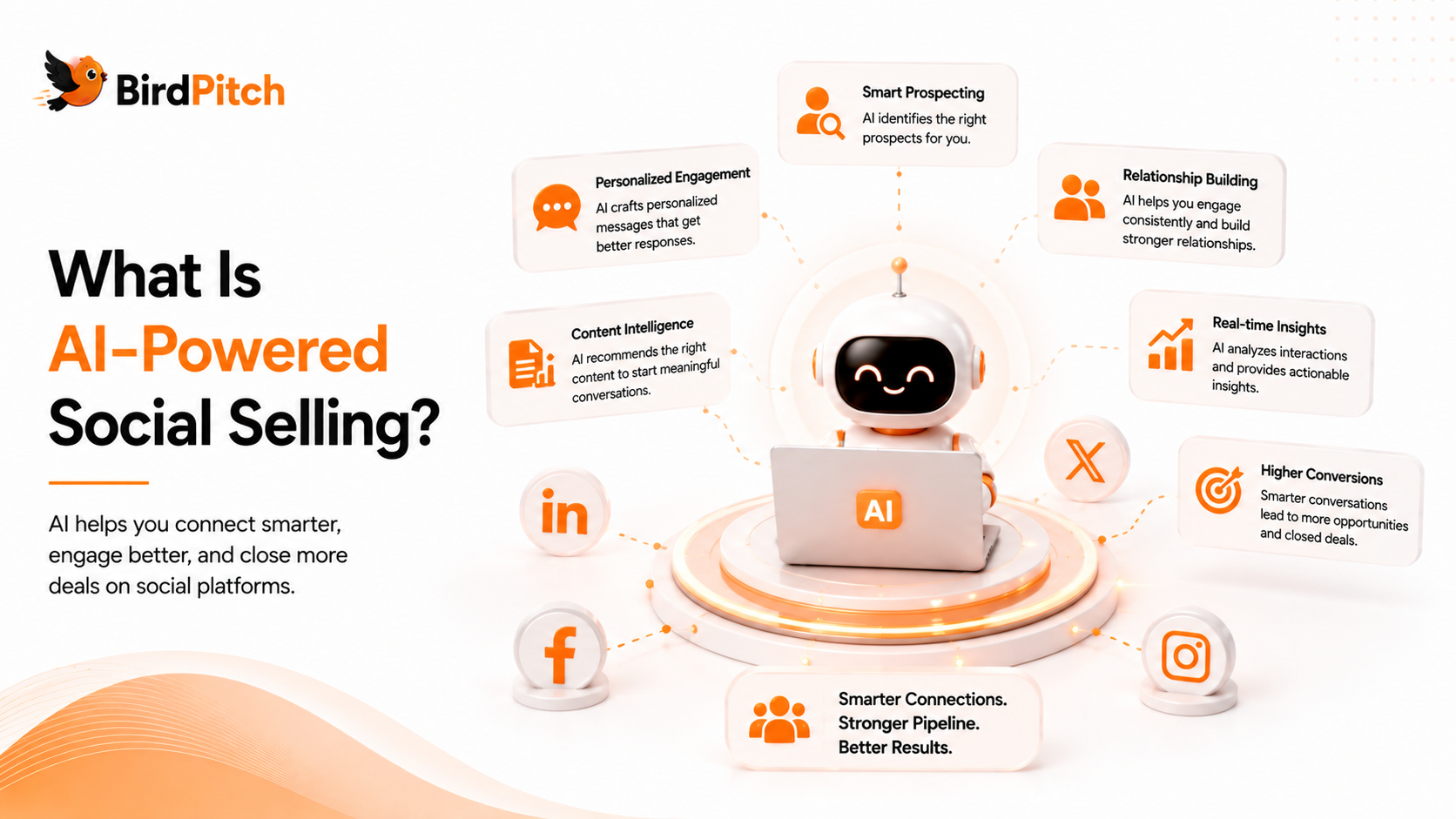
AI social selling automates personalized X engagement at scale. Learn how it works, why it converts better, and which metrics matter most.
The traditional sales playbook is dying in the age of digital noise. While your competitors are still cold-calling and sending generic LinkedIn messages that end up in the spam folder, the most successful growth hackers are moving their conversations to where the real decisions are happening: public social feeds.
Introduction
In the modern B2B landscape, the distance between a "potential lead" and a "closed deal" has shrunk, but the difficulty of finding that lead has increased. This is where the paradigm shift occurs. To understand the current evolution of outbound sales, one must ask: What Is AI-Powered Social Selling? Complete 2026 Guide.
At its core, social selling is the process of developing relationships as part of the sales process. It’s about using social media platforms to find, connect with, and nurture sales prospects. However, "traditional" social selling—manually scrolling through hashtags and typing out manual replies—is no longer scalable. It is a time-intensive, soul-crushing task that prevents sales teams from actually closing deals because they are too busy finding them.
AI-powered social selling changes the equation by injecting intelligence into the discovery and engagement phases. Instead of a human spending four hours a day monitoring keywords, AI algorithms can scan millions of data points in real-time to identify "intent signals." These signals tell you exactly when a prospect is complaining about a problem your product solves or asking for a recommendation in your niche. By leveraging Large Language Models (LLMs), businesses can now engage in hyper-personalized, context-aware conversations at a scale that was previously impossible.
Key Strategies
To master AI-powered social selling, you must move away from "broadcast" marketing and toward "precision engagement." Here are the three pillars of a successful 2026 strategy:
1. Intent-Based Discovery
The most effective strategy is no longer targeting a list of companies, but targeting a list of moments. In the past, you might target "SaaS Founders." Today, you target "SaaS Founders who just posted a question about their churn rate." Using AI to monitor specific keyword queries allows you to jump into a conversation at the exact moment the pain point is expressed. This turns a "sales pitch" into a "helpful solution."
2. Contextual Personalization
The death of the "template" is here. Generic replies like "Great post! Thanks for sharing!" are actually damaging your brand reputation. AI-powered social selling uses Natural Language Processing (NLP) to analyze the sentiment and specific nuances of a post. A successful strategy involves using AI to draft a response that references a specific point the user made, demonstrating that you have actually read and understood their content.
3. Multi-Channel Orchestration
Social selling shouldn't live in a silo. A sophisticated strategy uses social media as the "top of the funnel" to trigger other actions. For example, an AI-detected conversation on X (formerly Twitter) should trigger a personalized LinkedIn connection request or a highly specific email follow-up. You are using social signals to inform your entire multi-channel outreach engine.
Step-by-Step Guide
Transitioning from manual browsing to an AI-driven workflow requires a structured approach to ensure you don't sacrifice authenticity for speed. Follow these steps to build your engine:
Step 1: Define Your "Intent Keywords"
You cannot monitor everything. You must define a list of "trigger keywords" that signal a need for your product. These shouldn't just be your product category (e.g., "CRM"), but rather problem-based queries (e.g., "How do I sync my data?" or "Why is my sales team struggling with X?").
Step 2: Automate the Discovery Layer
Manually refreshing feeds is a waste of high-value human capital. Set up automated "crawls" that scan your keyword lists across your target platforms. You need a system that works while you sleep, bringing a curated list of relevant conversations to your dashboard every morning.
Step 3: Implement the AI Drafting Layer
Once a relevant conversation is identified, use an AI model (like Mistral or GPT-4) to generate a draft reply. Pro tip: Never set your AI to "auto-post" without a human-in-the-loop review during the first 30 days. Use the AI to do the heavy lifting of drafting, but use your human expertise to give it the final "soul" and brand voice.
Step 4: The Human Engagement
This is where the sale happens. Once the AI has helped you find the lead and drafted the response, the human salesperson enters to handle the nuance, the objections, and the transition from a public thread to a private DM or a scheduled demo.
Step 5: Analyze and Refine
Track which keyword clusters yield the highest conversion rates. If "software recommendations" leads to more demos than "pain point complaints," shift your AI discovery parameters to focus more heavily on the former.
Common Mistakes
Even with the best technology, many B2B teams fall into traps that can actually hurt their brand.
The "Bot" Trap: The biggest mistake is letting AI run completely unmonitored. If your AI generates a response that is slightly off-base or misses a sarcastic tone, you look like a spam bot. This destroys the trust required for social selling. Always maintain a "Human-in-the-loop" workflow.
Over-Automation: Automation should be used for discovery and drafting, not necessarily for the closing. If you try to automate the entire relationship from "Hello" to "Here is my Calendly link," you will encounter high friction and low conversion.
Ignoring Sentiment: Not all conversations are opportunities. Sometimes, a user is venting about a competitor, and sometimes they are venting about a topic entirely unrelated to your industry. If your AI isn't tuned to recognize sentiment, you might find yourself jumping into a heated argument, which is a PR nightmare.
Neglecting Profile Optimization: You can have the best AI-generated reply in the world, but if the profile you are posting from looks like a ghost town or a blatant advertisement, no one will click. Your social profiles must be optimized to act as landing pages that prove your authority.
Conclusion & Next Steps
AI-powered social selling is not about replacing the salesperson; it is about augmenting the salesperson's ability to find the right people at the right time. By automating the "search and draft" phases, you free up your team to do what they do best: building genuine, high-value human relationships.
As we move through 2026, the gap between companies using AI-driven discovery and those relying on manual browsing will only widen. The winners will be those who use AI to listen more effectively than their competitors, allowing them to respond with more relevance and less noise.
If you are ready to stop scrolling and start selling, BirdPitch can help you automate your discovery and drafting process. Our platform uses advanced AI to find the conversations that matter to your business so you can focus on closing. Try BirdPitch today and reclaim your time.
Writing about social selling on the BirdPitch blog. @birdpitchx