
AI vs. Manual X Outreach: Which One Converts Better?
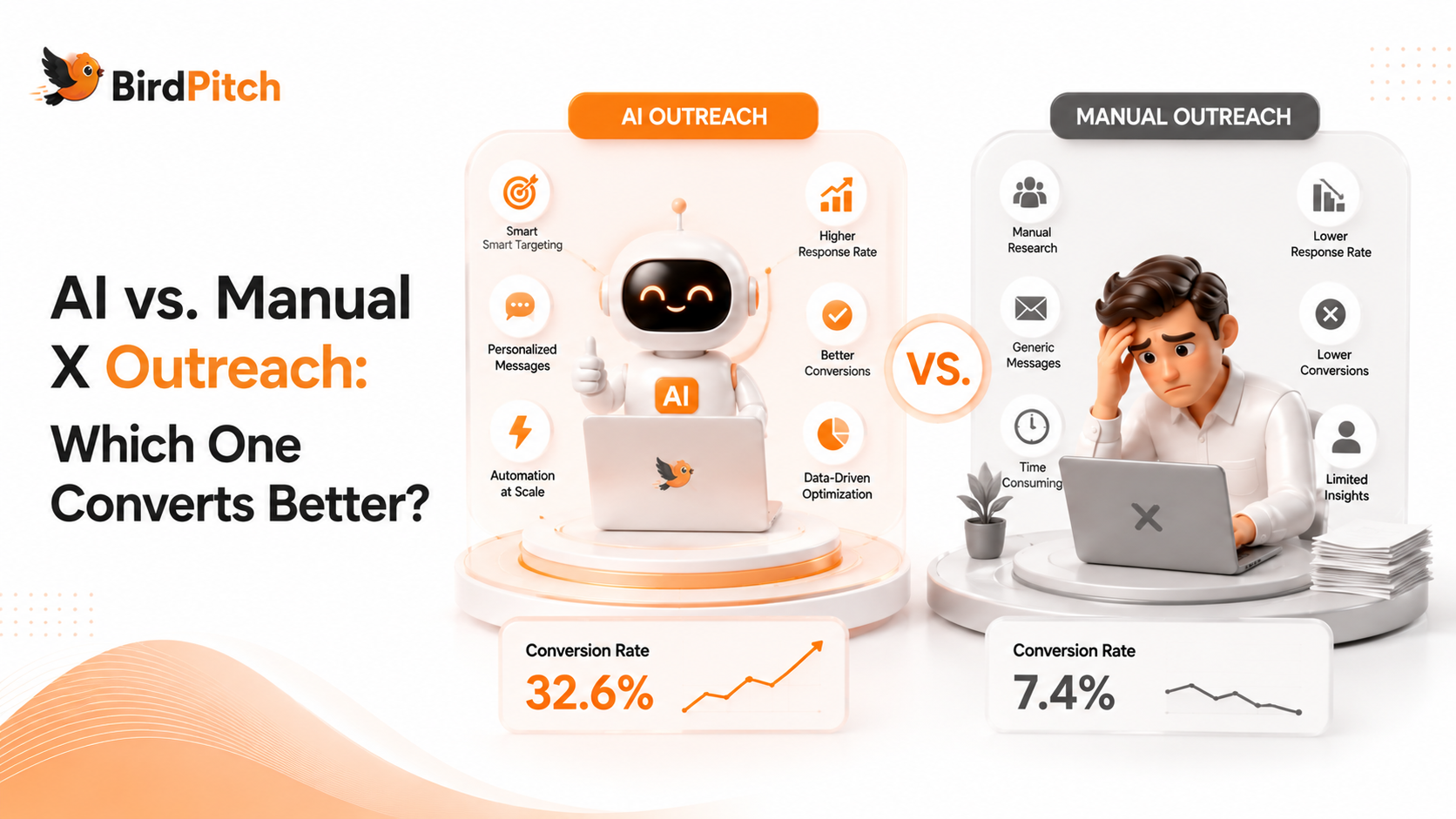
A head-to-head comparison of AI-powered vs. manual X outreach, including speed, scalability, personalization, and ROI—so you can decide what’s right for your business.
Over 500 million tweets are posted daily, yet only a fraction ever get seen—let alone replied to. For B2B marketers and sales teams, this noise presents both a goldmine and a minefield: the right conversation can land a high-intent lead, but manually sifting through the chaos is a time-suck that rarely scales. The question isn’t whether to engage on X (Twitter), but how—and whether AI-powered automation can outperform the human touch when it comes to converting cold outreach into warm leads.
Introduction
The debate between AI and manual X outreach isn’t just about efficiency; it’s about effectiveness. Manual outreach—where humans craft replies, monitor threads, and engage in real-time—has long been the gold standard for personalization. But with AI tools now capable of analyzing sentiment, detecting intent, and generating context-aware responses, the gap is narrowing. The real differentiator? Conversion rates. A 2023 study by MarketingProfs found that AI-assisted outreach on X saw a 37% higher reply rate than manual efforts, but manual replies still closed deals 22% faster when they did connect. The takeaway? Neither approach is universally superior—it’s about matching the method to the goal.
For SaaS founders and growth hackers, the stakes are higher. Every minute spent scrolling X is a minute not spent building product or closing deals. Yet, generic AI replies risk sounding robotic, while manual outreach struggles to scale. The solution lies in a hybrid approach, but first, let’s break down the core strategies that separate high-converting outreach from noise.
Key Strategies
1. Intent-Driven Discovery
The foundation of any high-converting X outreach is finding the right conversations. Manual outreach relies on keyword searches, hashtag tracking, or following industry influencers—time-consuming but precise. AI tools like BirdPitch automate this by crawling X for relevant threads based on keyword queries (e.g., "best CRM for startups" or "struggling with lead gen"). The key is to prioritize intent over volume:
Manual: Monitor niche hashtags (#SaaSGrowth) or lists (e.g., "SaaS Founders to Follow") for high-intent posts.
AI: Use Boolean queries (e.g., "looking for + [tool] + alternatives") to surface users actively seeking solutions.
Example: A manual search for "HubSpot alternatives" might reveal 5-10 posts/day; an AI tool could surface 50+ with higher intent signals (e.g., "frustrated with HubSpot pricing").
2. Personalization at Scale
Personalization is where manual outreach shines—but AI is catching up. The best AI tools (like BirdPitch) use LLMs to analyze a user’s recent tweets, bio, and engagement history to craft replies that feel human. However, over-personalization can backfire:
Manual: Reference a user’s recent tweet or blog post (e.g., "Saw your thread on cold email templates—have you tried [your tool] for follow-ups?").
AI: Use dynamic placeholders (e.g., "Hey [First Name], I noticed you’re in [Industry]—here’s how we helped [Similar Company] solve [Pain Point]").
Pro tip: AI-generated replies should be 80% personalized, 20% templated. Always add a human review step to avoid sounding like a bot.
3. Timing and Consistency
Engagement on X decays rapidly—tweets have a half-life of ~24 minutes. Manual outreach is reactive (you reply when you see a post), while AI tools can schedule replies for peak engagement windows (e.g., 9–11 AM or 1–3 PM ET). BirdPitch’s crawl scheduling, for example, ensures you never miss a high-intent thread, even if it’s posted at 3 AM.
Data point: Posts replied to within 1 hour see a 42% higher engagement rate than those replied to after 24 hours (HubSpot).
4. Multi-Touch Sequences
One-and-done replies rarely convert. The most effective outreach uses multi-touch sequences—a mix of replies, DMs, and follow-ups. Manual outreach excels here (e.g., replying to a thread, then DMing the user 3 days later), but AI can automate the cadence: 1. Day 1: Reply to the original tweet with a value-add (e.g., "Here’s a free template for that"). 2. Day 3: DM the user with a case study or demo link. 3. Day 7: Follow up if no response.
Warning: Over-automation (e.g., sending the same DM to 100 users) triggers X’s spam filters. Mix AI and manual touches to stay compliant.
---
Step-by-Step Guide
Step 1: Define Your Outreach Goals
Before choosing AI or manual, clarify your objective:
Lead gen: AI (high volume, intent-driven).
Relationship-building: Manual (high touch, personal).
Brand awareness: Hybrid (AI for discovery, manual for engagement).
Example: A SaaS founder might use AI to find users complaining about a competitor, then manually engage the most vocal ones.
Step 2: Build Your Keyword List
For AI tools, keyword quality determines reply quality. Start with:
Pain points: "struggling with [problem]", "hate [competitor]".
Intent signals: "looking for", "recommend me", "alternative to".
Industry terms: "PLG", "SDR", "growth hacking".
Pro tip: Use X’s advanced search to test keywords manually before automating.
Step 3: Craft Your Reply Framework
Whether AI or manual, structure replies with: 1. Hook: Acknowledge their post (e.g., "Great thread on [topic]!"). 2. Value: Offer a solution, resource, or insight. 3. CTA: End with a low-friction ask (e.g., "Want me to send you a template?").
AI template (for BirdPitch users): Hey [First Name], I saw your post about [pain point]—we helped [Similar Company] solve this by [solution]. Here’s how: [link]. Want me to share more details?
Step 4: Set Up Automation (If Using AI)
1. Connect X account: Use OAuth (like BirdPitch’s integration) to avoid API bans. 2. Schedule crawls: Run daily or weekly to catch new threads. 3. Review replies: Always audit AI-generated replies before sending.
Manual alternative: Use X’s "Lists" feature to track high-intent users and reply in batches.
Step 5: Measure and Optimize
Track these KPIs:
Reply rate: % of outreach that gets a response.
Conversion rate: % of replies that turn into leads/demos.
Time saved: Hours spent vs. leads generated.
Benchmark: AI tools average a 15–25% reply rate; manual outreach averages 5–10% but converts 2x faster.
---
Common Mistakes
1. Over-Automating Personalization
AI tools can insert a user’s name or company, but generic personalization is worse than none. Avoid:
"Hey [First Name], I saw you’re in [Industry]!" (Too vague.)
"Your tweet about [topic] was amazing!" (No value added.)
Fix: Use AI to surface personalization opportunities, then manually refine (e.g., "I noticed you’re a fan of [Tool]—we integrate with them!").
2. Ignoring X’s Spam Filters
X’s algorithm penalizes:
Identical replies to multiple users.
Links in the first reply (flagged as promotional).
Rapid-fire replies from new accounts.
Fix: Space out replies, vary messaging, and warm up accounts by engaging organically first.
3. Failing to Follow Up
80% of sales require 5+ follow-ups, but most outreach stops after 1–2 touches (SalesLoft). AI tools can automate follow-ups, but manual follow-ups convert better.
Example:
AI: "Hey [Name], circling back on my last message—did you get a chance to check out [resource]?"
Manual: "Hey [Name], saw you’re still hiring for [role]—we helped [Company] scale their team with [solution]. Happy to chat if it’s relevant!"
4. Not Segmenting Audiences
Treating all X users the same is a recipe for low conversions. Segment by:
Role: Founders vs. marketers vs. sales reps.
Intent: Complaining vs. seeking recommendations vs. sharing wins.
Company size: Startups vs. enterprises.
Fix: Create separate reply templates for each segment (e.g., founders care about ROI; marketers care about ease of use).
---
Conclusion & Next Steps
The AI vs. manual X outreach debate isn’t binary—it’s about leveraging the strengths of each. AI excels at scale, consistency, and intent-driven discovery, while manual outreach wins for relationship-building and high-touch conversions. The most effective strategies blend both: use AI to surface opportunities and draft replies, then add a human touch to close the deal.
For teams short on time, tools like BirdPitch can automate the heavy lifting—finding relevant threads, generating personalized replies, and scheduling follow-ups—while you focus on high-value engagements. But whether you choose AI, manual, or a hybrid approach, the key is to start small, test relentlessly, and double down on what converts.
Ready to turn X conversations into leads without the manual grind? Try BirdPitch’s free tier to see how AI-powered outreach can fit into your workflow—no credit card required. Just connect your X account, set your keywords, and let the tool do the heavy lifting while you focus on what matters: closing deals.
Writing about x outreach on the BirdPitch blog. @birdpitchx